SESSION 0
You’ve got mail!
The night watch on the border of Sylvanthe had one great advantage, which was that nothing ever happened on it. The wood elves had spent several centuries making sure nobody outside the forest had heard of their city, and they had been so thorough about it that even the bandits had given up. Corin sat by a small fire near midnight with his back to an oak, his longbow across his knees and a strip of dried venison in his teeth, and listened to the forest doing its usual business. An owl complained. A branch creaked. Somewhere to the east a badger was digging with the dedication of a creature that had never once been asked to justify itself.
He had been doing this for years now, long enough to be good at it and long enough to be bored by it, and he had learned that boredom was the reason people died on watch. So he kept looking. He looked at the dark between the trunks and at the ferns and at the low holly bushes to his left, and that was why he saw the leg.
It was a human leg. There was a boot at the bottom of it and, presumably, a human at the top, though the rest was hidden behind the holly. It moved very slowly, the way a leg moves when its owner has decided to sneak up on somebody and is taking the job seriously. Corin put down the venison. He did not reach for his dagger, although his hand wanted to, because a dagger meant letting whoever it was get close. Instead he rose into a crouch, nocked an arrow and drew the bow in one motion, the string cold against his cheek.
“Halt,” he said. “Who goes there?”
The holly rustled, and then the leg was no longer behind it. It was three bushes further to the left, which was not a distance any leg should cover between one breath and the next. Corin swung the bow after it. He had grown up among people who could move like that, and he had hoped never to see it again.
“Don’t move,” he said, and felt a little foolish, because clearly the leg had no intention of following instructions.
He waited. The fire popped. Then he heard movement from the left and from the right at once, too quick and too even to be one person, and the leg was gone entirely. He turned in a half circle with the arrow still drawn, searching the ferns, the trunks, the patch of moonlight on the path, and found nothing anywhere. He had very sharp eyes. The whole city relied on it. For a long, ridiculous moment he stood aiming his bow at an empty forest and wondered whether he had imagined the whole thing.
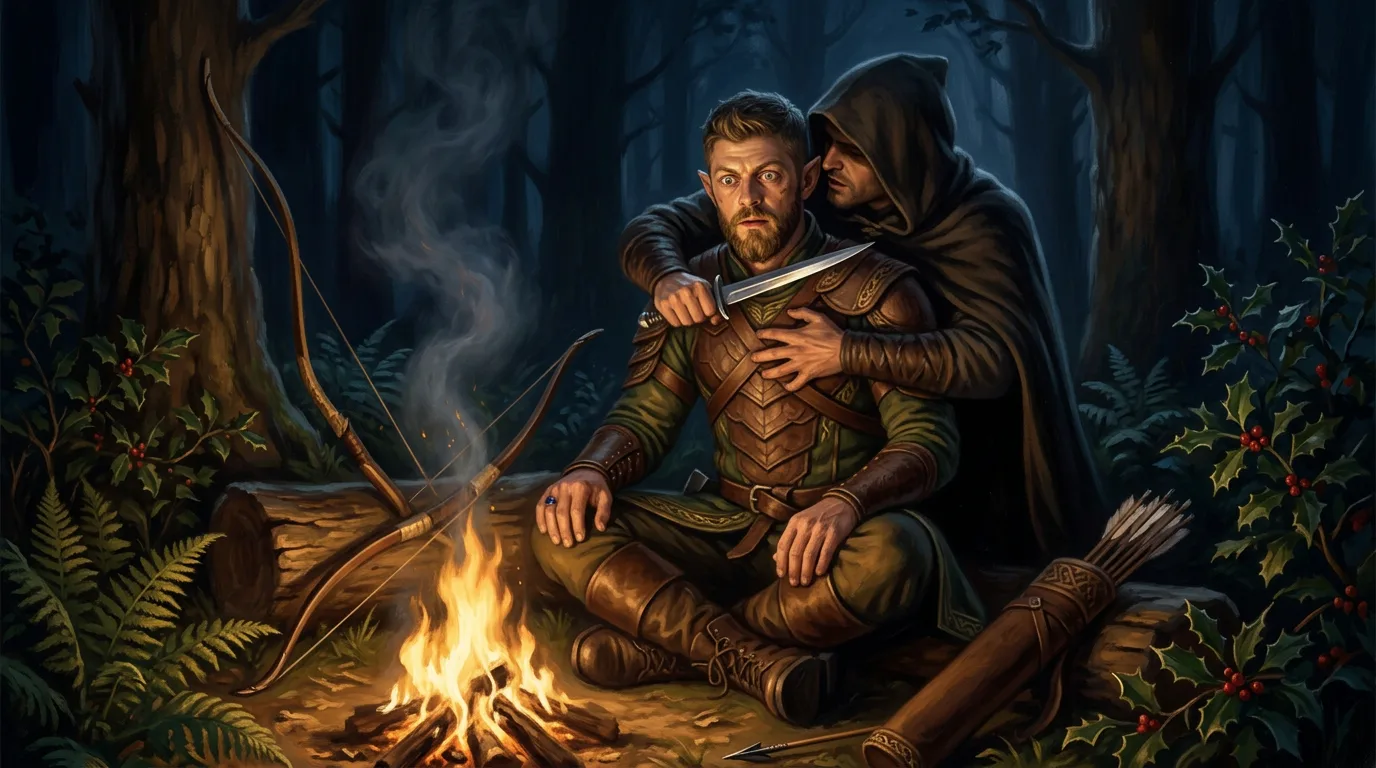
He had not. The blade touched his throat from behind, cold and very precise, resting exactly on the vein. An arm came around his chest and held him. It held him a little closer than a threat required, and a little longer, and the breath at his ear smelled of crushed grass and of a human, and under that of a person he had met before. He knew that voice. He could not have said from where.
“It’s good to see you again,” the voice whispered. “It’s been a while since I got to hold you like this.”
Corin did not move. He had been trained, once, by a man who had made very sure he knew what a knife at the throat meant, and the training had taken. His fingers stayed on the bowstring. His heartbeat was loud enough that the stranger could surely feel it through his armor.
“I’m only here to say hello,” the voice said, almost fondly. “To leave you my regards. And to tell you one thing. If you ever want to find out what happened to your mother, take the job offer.”
Then the arm was gone and the knife was gone, and when Corin spun around there was nobody behind him. There was only a thin smear of smoke drifting through the firelight, which smelled faintly of the same grass, and dissolved before he could reach out to touch it.
He stood there for a while. The owl, which had gone quiet, started complaining again. Eventually Corin lowered the bow, walked twice around the fire, checked the holly and the ferns and found a single boot print, pointed toward him, and no second one pointing away. He sat back down against the oak because there was nothing else to do, and because the watch was not over, and he put his hand into the inside pocket of his coat to find the flint for the fire.
There was a letter in it. He had not put it there. The envelope was heavy and cream colored and sealed with red wax pressed into the shape of a posthorn, and his name was written across the front in handwriting so neat it looked printed. He turned it over three times. Then he broke the seal with his thumb and read, by firelight, that the administration of the Everpost was delighted to invite him to an interview for a position that required his very particular abilities, background and experience, and that it very much looked forward to meeting him.
Corin read it twice more. Then he looked out into the forest, where the dark between the trees was exactly as empty as before, and said nothing at all.
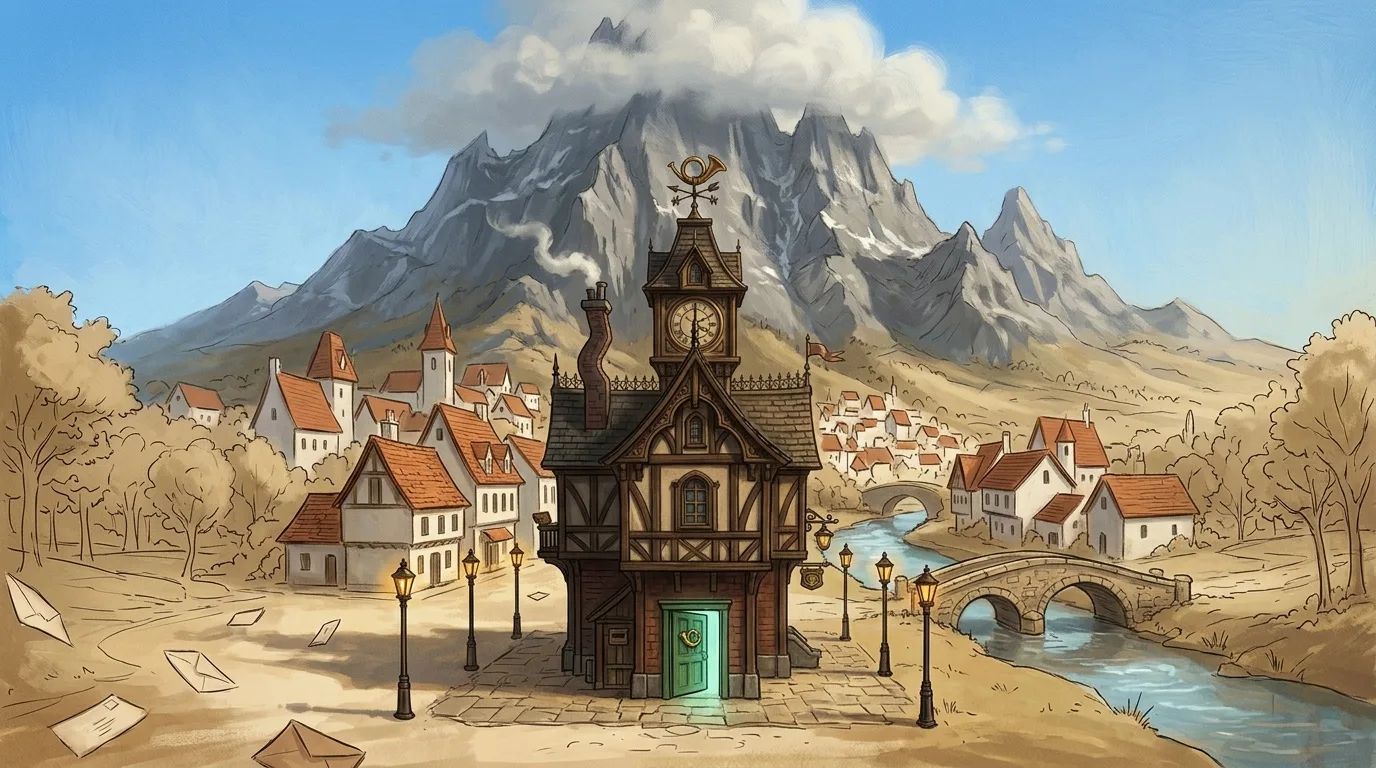
Wyrmsfoot on a sunny morning looked like a painting of a town that somebody had done to prove that nothing bad ever happened anywhere. The houses were whitewashed and the roofs were red, the river ran politely under a stone bridge, and above all of it rose Wyrm Mountain, gray and enormous and wearing a cap of cloud. Everyone in Wyrmsfoot knew that the Creator lived up there, the great dragon who had made humanity, and everyone knew that the last people to climb up and say hello had never come back down, so the town had settled on worshipping the mountain from a respectful distance and getting on with the laundry.
Dorian crossed the bridge in his best coat, which was also his only coat that had never been used to carry firewood. Next to him, at about the height of his elbow, floated Celestine. She wore a pink dress with lace at the cuffs and a pink top hat nearly as tall as she was, and she drifted along with her ears perfectly straight and her nose in the air. When they had first arrived in Wyrmsfoot, the market had emptied every time she floated through it. By now people only nodded, and one of the bakers had started calling her “madam”, which she considered the bare minimum.
“You are frowning,” Celestine said without looking at him.
“I’m thinking.”
“You are frowning while thinking. It gives you lines. If you get the job, you will need to look presentable.”
He had the letter in his pocket. It had appeared in his belongings on the morning of his twentieth birthday, sealed and addressed, and it spoke of a job for someone with special abilities. Dorian did not like the phrase special abilities. He did not like anything that suggested he was a sorcerer, because he was not one, or at least he had decided very firmly that he was not one, and he had kept to that decision for ten years with only the occasional lapse involving candles. But the letter had also mentioned a salary, and Wyrmsfoot was expensive, and Celestine’s hats did not pay for themselves.
The post office stood at the end of the street, a tall narrow building with a brown door. In front of the brown door stood a young woman in a long red dress with flounces at the hem, dark hair wound up into a bun with two pencils pushed through it, a notebook under one arm. She was pulling at the door handle with great determination. The door was not moving.
“Oh, hi,” she said when she saw him. “I don’t think we’ve ever properly met, but I think I’ve seen you around. I’m Agata. I’m from a little village nearby. Monteluna. You probably don’t know it.”
“I don’t think I’ve heard of it,” he said, and gestured at the bunny beside him. “This is... well. I should probably let her introduce herself, or she’ll be furious.”
“Celestine Bonbon,” said Celestine. “And if you would speak to me directly in future, I would appreciate it.”
Agata’s eyes went wide and delighted. “I love the floating,” she said. “Crazy. Sorry. Hello, Celestine.”
Agata had found her letter in her sleeve, which Dorian thought was a strange place to find anything. When she asked why he wanted the job, he told her that he had prayed to the gods and the gods had told him that at this very office he would receive a cerulean scroll, and that he was here for the blue card. Agata nodded seriously and said that whenever you moved to a new town you always needed papers of some kind, she remembered it well.
Then she tried the door again. When that failed, she walked along the front of the building and tried the window, pushing at the frame from the wrong side, and then tried it from the other wrong side. Dorian watched this for a while. He remembered, with growing certainty, a line near the bottom of his letter. For the sake of appearances, we kindly ask all applicants to use the employee entrance at the rear. The front door may be closed for business.
“I think we need to use the employee entrance,” he said. “It’s at the back.”
“Oh, true! You’re so smart. Thank you.”
Behind them, Celestine rolled her eyes so hard her hat tilted.
The back of the post office had a small brown door with a brass knocker. Agata knocked. From inside came an old woman’s voice, bright and fluting. “Oh, my dears, give me just one second, I’ve got tea on the stove.” Footsteps approached, soft and slapping, the sound of shoes much fancier than any old woman needed to shuffle to a door. Then the door opened, and light came out.
Dorian had seen a lot of light in his life. He had seen the glow of a village burning at night, which he did not think about. He had never seen this color. It was warm and pale and belonged to no hour of the day he knew. The smell that came with it was of herbs and fruit tea with roses in it and of cookies baking somewhere close, and every one of those smells was very slightly wrong, the way a word starts to look wrong after you have written it fifty times in a row. Nothing about it was unpleasant. His skin prickled anyway.
The woman in the doorway wore a faded red postal uniform with a jacket and, under the skirt, a pair of battered hiking boots. Her gray hair was pinned up with pencils. There was ink on her fingers. She could have been eighty or five hundred, and she was smiling at them with her whole face.
“Come in, come in, my dears! I’m so happy you got the invitations from the book. Come in, I have tea. Oh, and I forgot to introduce myself, I got far too excited. I’m Maggie. Margaret Quill, if you want the whole thing. I’m the head of the Everpost.”
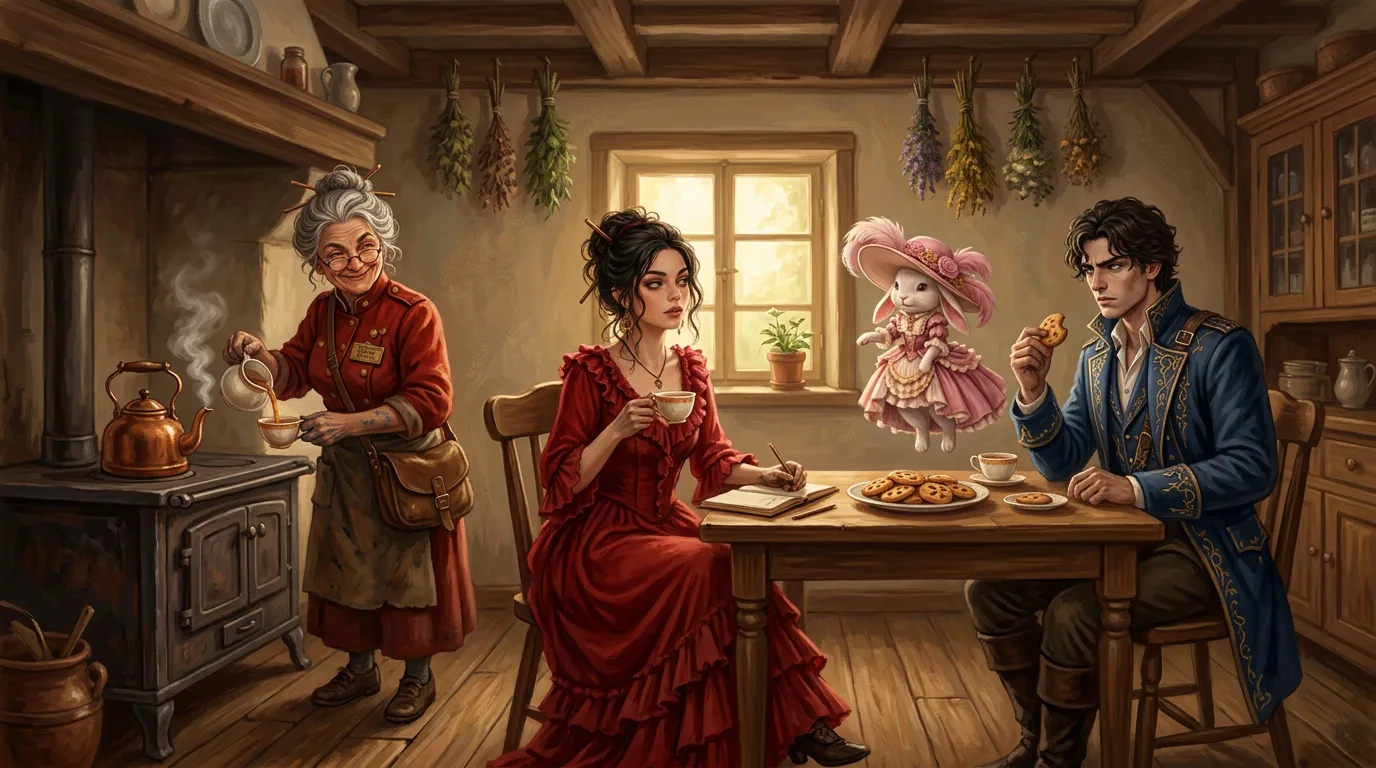
Beside him, Agata had gone very still, staring past the woman into the kitchen with an expression Dorian could not read. Then she smiled and followed Maggie in, and told her that true beauty was timeless, and Maggie laughed and said she was not going to make the job interview any easier for her and then immediately made it easier by giving her three cookies.
Maggie poured tea and handed them each a form for the compliance officer. Just in case of death and so on, she said. Sometimes one gets chased by a dog. The book had already decided they were hired, she said. She had had an eye on them for a while. They had nudged the authorities a little. When Agata asked, very politely, how she knew about them, Maggie opened her mouth, pulled out a pocket watch, looked at it and said, “Oh, fuck.”
Celestine dropped her cookie.
“I’m so sorry, girls, I’m so late. I have another interview. Head down those stairs and you’ll meet Portobello. He’s probably hiding in a dark corner. He doesn’t like light much.” And she was gone in a swirl of red and pencils, leaving them with the tea.
Maggie’s office was darker than her kitchen and much more reassuring. It had a heavy oak desk and pigeonholes full of letters and a rack of rubber stamps in graduated sizes, and Horatio, who had been sitting in front of the desk for eleven minutes with his hands folded on his knee, had spent the time sorting the stamps by size in his head and finding them already in order. That was a good sign. An office where the stamps were in order was an office where things were done properly.
He had dressed for the occasion in his long brown shirt with the good buckles, and he had combed his hair back and tied it so that not a strand was loose, and he had cleaned his glasses twice. He was aware that most people who saw him for the first time saw an orc. His skin was gray-green and his tusks, though small, were there, and he had long ago accepted that people would look at the tusks first and the glasses second, if at all. The amulet on his chest with its red stone usually came a distant third.
On the chair beside him sat an elf. Horatio had not been introduced, but the pointed ears and the brown and green leathers and the long bow leaning against the wall were not difficult to interpret. The elf sat very upright with one hand never far from the dagger at his belt, and his eyes kept moving from the door to the window to Horatio and back to the door. Horatio had nodded to him once, which he felt covered the social obligations of the situation.
Between them, on a brass stand on the desk, sat a crystal ball the size of a cabbage. It was not doing anything.
The door flew open and Maggie came in with a tray, apologizing. She had made tea, she had forgotten the cookies again, she was so happy to have them, they had been waiting so long to meet them. She sat down behind the desk and beamed at Horatio.
“So, Horatio. Tell me, why would you like to work here?”
Horatio had prepared an answer. He had prepared three, in fact, of different lengths, and he chose the medium one. “Being part of the Everpost is an honorable and honored tradition,” he said. “The public service aspect is something I aspire to.”
“Oh, that’s wonderful. Don’t we all aspire to things?” She turned to the elf. “And you, Corin? What brings you here, apart from a letter?”
“A letter that showed up,” the elf said. “I had a feeling I needed to come. Some people around me pushed a little.”
“Well, sometimes we all get pushed toward things that are better for us in the long run.” Maggie slid two thick documents across the desk. “There are a few formalities. Insurance, compliance, legal things. A little job contract. Fill it out whenever you’re ready and give it to Portobello, he’s our head of legal, he’ll be waiting downstairs.” Then she frowned, which looked odd on her face, and rapped her knuckles on the crystal ball. Nothing happened. She rapped again. “We have a fifth applicant today,” she said. “He’s supposed to join us remotely, but apparently he can’t be bothered. We’ll figure that out later.”
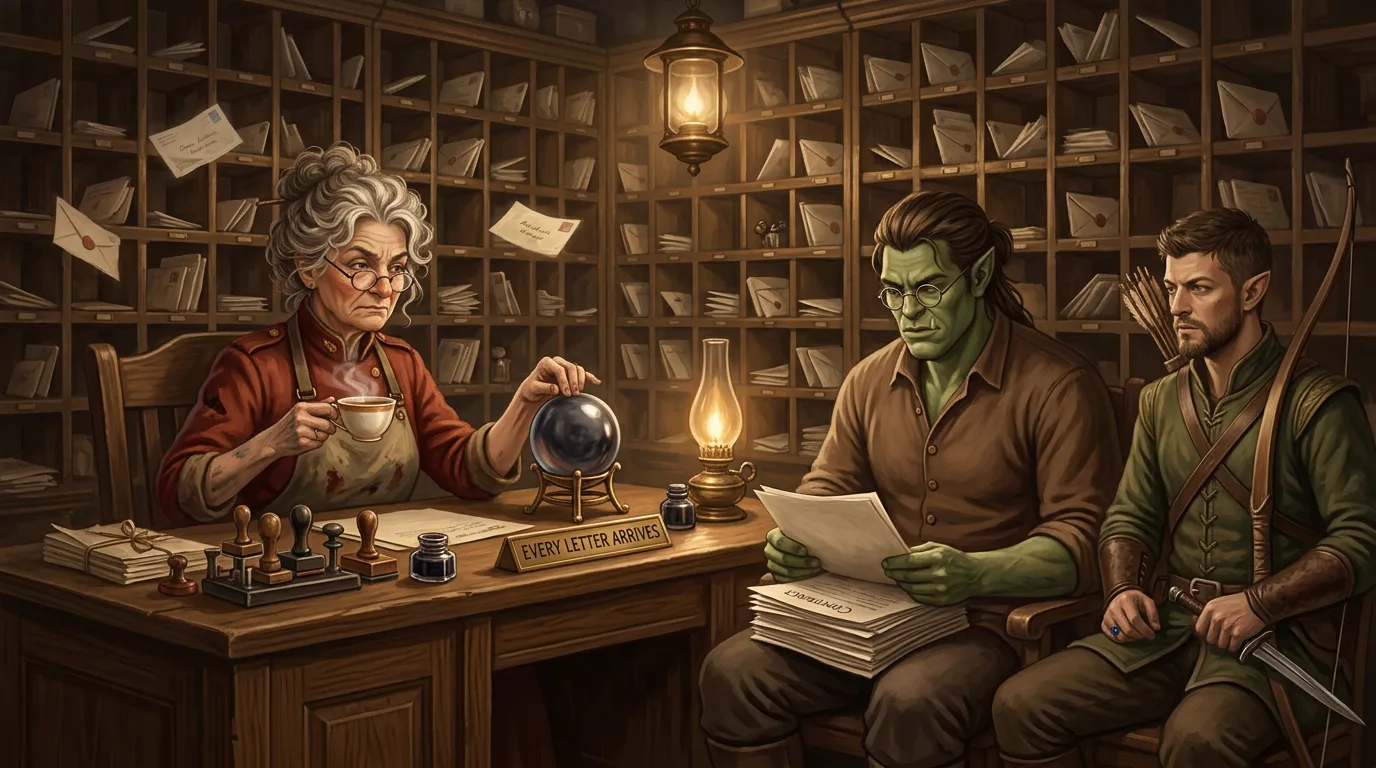
Horatio opened the contract. It was forty-one pages long and had numbered paragraphs, and he felt his shoulders relax for the first time that morning.
“What does the rest of the interview process look like?” Corin asked.
“Oh, that was the interview,” said Maggie. “You’re hired.”
She said it the way people say that it is Tuesday. Horatio looked up from paragraph three.
“But,” he said. “I thought the selection was based on excellence.”
“Oh, it is. The book chooses by excellence, and you’ve been chosen. You passed the moment you walked into the house.”
Horatio put the contract down very carefully on his knee. He had spent a week preparing for this. He had expected an examination at the very least, possibly several, with a written component and a practical one and a panel of stern people taking notes. On the previous evening he had asked his reflection a series of difficult questions about postal regulation and answered most of them correctly.
Maggie studied his face for a moment, and understanding dawned on hers. “Oh,” she said. “You wanted a rigorous process.” She laughed, a small delighted sound. “I never thought I’d say this in my very long life, but I think you might actually be pleased to meet Portobello. I think you two are going to get along.”
“Not at this time,” Horatio said. “But rest assured, if questions arise, I am not shy. I will ask.”
“Beautiful. That’s what we’re here for. I’ll answer everything I can.”
He watched her as she said it. He had grown up at court, where everybody answered everything and nobody said anything, and he had learned to listen for the place where a sentence thinned out. It was there in her voice, very faint, under all the warmth. She would tell them a great many things, and there was at least one thing she would not tell them, no matter how nicely they asked.
“That,” he said, mostly to himself, “is simply called the human experience.”
Maggie smiled at him and said nothing, which he felt proved his point.
They were dismissed with a wave toward the stairs. In the corridor, Corin stopped, turned and held his unread contract out toward Maggie, who was already bustling off in the other direction.
“No,” said Horatio. “She said to give it to Portobello. The head of legal. Downstairs.” He tapped the page. “Also, you haven’t signed it. Also, you haven’t read it. Paragraph nine alone is four pages.”
Corin looked at him the way elves look at most things, which is from a slight height, and then he folded the contract into his coat without comment. Horatio decided that he would read both copies.
He was thinking, as they walked down the corridor, of another postmaster, a long time ago. A dwarf with a beard like steel wool who had given a small, strange-looking boy a biscuit and asked him how he was, and waited for the answer. It had been the first time anyone had done that. Horatio adjusted his glasses and went down the stairs.
The cellar was a larger version of the kitchen, if the kitchen had been dug underground and filled with shelves. There were shelves of letters and parcels, a long table and a chalkboard, and Agata had been standing in it with Dorian and Celestine for several minutes, looking for a man called Portobello in all the dark corners, when footsteps came down the stairs behind them.
She turned around and saw a monster and an elf.
That was her first thought, and she was not proud of it. The monster had gray-green skin and small tusks in its lower jaw, and it wore tiny round glasses and a shirt with more buckles than she had ever seen on one person. The elf had pointed ears. Actual pointed ears, the kind from her grandmother’s stories. In Wyrmsfoot there were only humans. In Monteluna there had only been humans. Agata had spent twenty-two years believing everything else was a bedtime story, and now two bedtime stories were walking down the cellar stairs, and she could feel her face trying to do several things at once.
She held it. Mostly. “Nice to meet you,” she said brightly. “You look normal.”
The one with the tusks regarded her through his glasses. “Thank you for pointing that out. I try my very best to look normal every day.”
“You really manage it,” Agata said, and then decided to stop talking.
They exchanged names. The one with the tusks was Horatio, the elf was Corin, and Corin, whose eyes went to everyone’s belt before their face, looked at the bunny last and asked, “And who is this?”
“Celestine,” said Celestine. “Thank you for asking. Finally someone did.”
“I did not realize you could talk,” said Horatio.
It was Horatio who found Portobello. He went to each corner in turn, peering, and in the fourth one there was a mushroom. It was very large and very green and stood facing the wall with its hands clasped behind its back, and when Horatio cleared his throat it turned around with the expression of a mushroom that had been hoping this would not happen today.
“Oh. This commotion already. Let’s get this over with,” it said. “My name is Portobello Grimm. My friends, if I had any, would call me Mr. Grimm, and you are welcome to do the same.”
He had a clipboard. He consulted it. “Onboarding, paragraph seventeen. According to this, I am pleased to meet you.” He looked up. “Kind of. I hope you will find the Everpost your home. Or not.” He pointed toward the stairs. “The emergency exit is on the left. There will be no life vests provided, because we are in a fucking cellar.”
Agata glanced at Dorian. Dorian was biting his lip very hard.
Mr. Grimm then spent ten minutes explaining the correct way to stamp a letter. He covered ink, angle and the several regulations violated by the wrong color, and he did it with more joy than Agata had ever seen on any face, fungal or otherwise. Horatio listened with the face of a man hearing the last will of a rich uncle. Agata tried very hard to look interested. Somewhere to her left, Dorian and Celestine were rolling their eyes at each other in turns.
“Now,” said Mr. Grimm, producing a small brass bell and a stack of envelopes, “forty letters. Twenty seconds. We are the Everpost, we have a great deal of mail. We do not have time forever, but we do things properly.”
“Would you have any tips,” Agata asked, “for someone doing it for the first time?”
“I have just given you ten minutes of tips,” said Mr. Grimm, and rang the bell.
She got to twenty-eight. Everyone else got to forty. Mr. Grimm looked at her twenty-eight for a long time and said that next time she should perhaps listen to the tips people gave her. Then he looked at Horatio’s forty, all at the same exact angle, and said, “I see promise. It needs practice. But I see promise,” and Horatio went a slightly darker shade of green.
After that Mr. Grimm blew a whistle. One of the shelves swung aside like a door, and out of the dark behind it came wolves.
Agata did not panic. She wanted that clear later, when she told the story. She made a plan. The plan was to be higher than the wolves, and she turned to the nearest shelf and began to climb it with great care, placing her foot on the second board, her hand on the fourth, her foot on the third. Unfortunately the third board existed mostly in her imagination. Her foot went through the space where it should have been, her weight went with it, and the whole shelf leaned, considered, and fell over with her on it in an avalanche of envelopes.
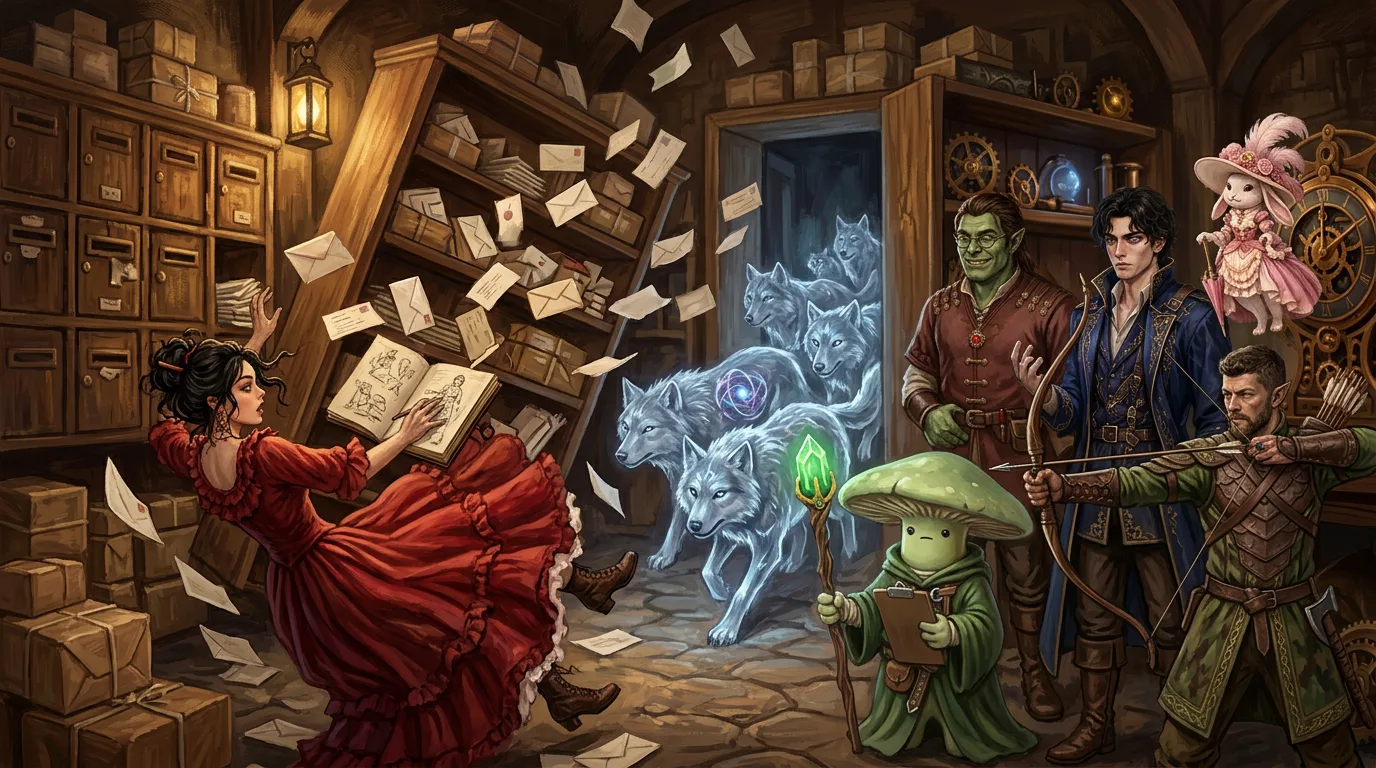
From under the letters she heard Horatio say, very calmly, “They are not making any noise.”
“They’re illusions,” said Dorian.
The wolves ran through the table without touching it. Mr. Grimm lifted his staff, the stone at its tip stopped glowing, and they were gone. The swung shelf swung back. “This,” said Mr. Grimm, “is what we call a chased-by-the-dog situation. On a positive note, you are alive.” He made a scratching noise on his clipboard. “Would you be so kind as to put those back in order? Alphabetically.”
Corin helped her lift the shelf. He did not say anything, but he sorted the letters with her, quickly and neatly, while Horatio muttered a word over a scratch in the wood and the scratch went away. When they were done, Mr. Grimm ran one green finger along the envelopes and made a sound Agata could only describe as a tick.
“Paragraph one hundred forty-three,” he said. “I am happy to congratulate you on your new positions.” From the pocket of his long green robe he took four badges. He gave the first to Horatio, then one each to her, Dorian and Corin. Hers was blue, with a silver globe on it and a small white envelope in front of the globe. She pinned it to her dress and felt ridiculously proud.
He gave them each a card printed with RETURN TO SENDER, which they would learn about eventually, and asked which of them would be the book bearer. Horatio said that naturally, if it involved books, he was suitable, and Mr. Grimm wrote it down. Then he turned the page on his clipboard, read the last line and paused.
“Oh. You are actually assigned to the special task force. Well. Sorry about the stamping. You will not be stamping letters. If you wish, you may file a complaint on form 17A, third room from the left.” He explained that the special task force delivered the things that were very hard to deliver, the letters that somehow had not arrived the first time, and that the Everpost had not needed one in two hundred years. Agata looked at him and wondered how old mushrooms got. “Your combat training will be in the void. Second broom closet on the left. And tell Talon he does not have my warm regards.”
He went back to his corner and faced the wall.
On the way upstairs Dorian mentioned that the small print on his letter excluded any responsibility if they died, were maimed, fell out of the sky or were torn apart by wolves. “Which seems normal,” he said. Agata did not think it was normal at all.
At the second broom closet on the left, Celestine floated up to the handle and pulled. It did not move. Horatio reached past her and pressed it, and it opened at once. Inside there was no broom. There was only white, going on forever.
Corin let two of them go first. It was not cowardice. It was the habit of a man who had been trained, a long time ago, never to be the first through a door, and it meant that he saw the mushroom’s broom closet swallow the half-orc and then Agata without so much as a ripple. Then he stepped through himself and came out through the front door of the post office into a place with no ground.
There was ground, technically. He was standing on it. It was white, the sky above it was white and the distance was white, and the post office behind him stood on a small square in the middle of all that white like a toy set down on a tablecloth. Paths led away from the square in every direction, marked by tall lamps. He could smell nothing at all. For the first time since the kitchen, he understood what the humans had meant about the colors being wrong, because now they were wrong for him too.
He was still taking this in when somebody stood behind him.
He did not hear it. He had not heard it in the forest either, and his body remembered, and it went cold all at once as a blade settled on his throat. But then he breathed in, and the smell was wrong. It was leather and cold stone and a little woodsmoke, no grass, no human. The arm across his chest was thinner. The weight was different, and the stance, and the way the knife sat.
It was not the same person. He let himself breathe out.
Whoever it was held him a moment longer than a threat needed, and the grip was, in a strange way, almost pleasant. “Oh, nice to meet you,” said a man’s voice at his ear, amused. “You’d be dead. But nice to meet you.”
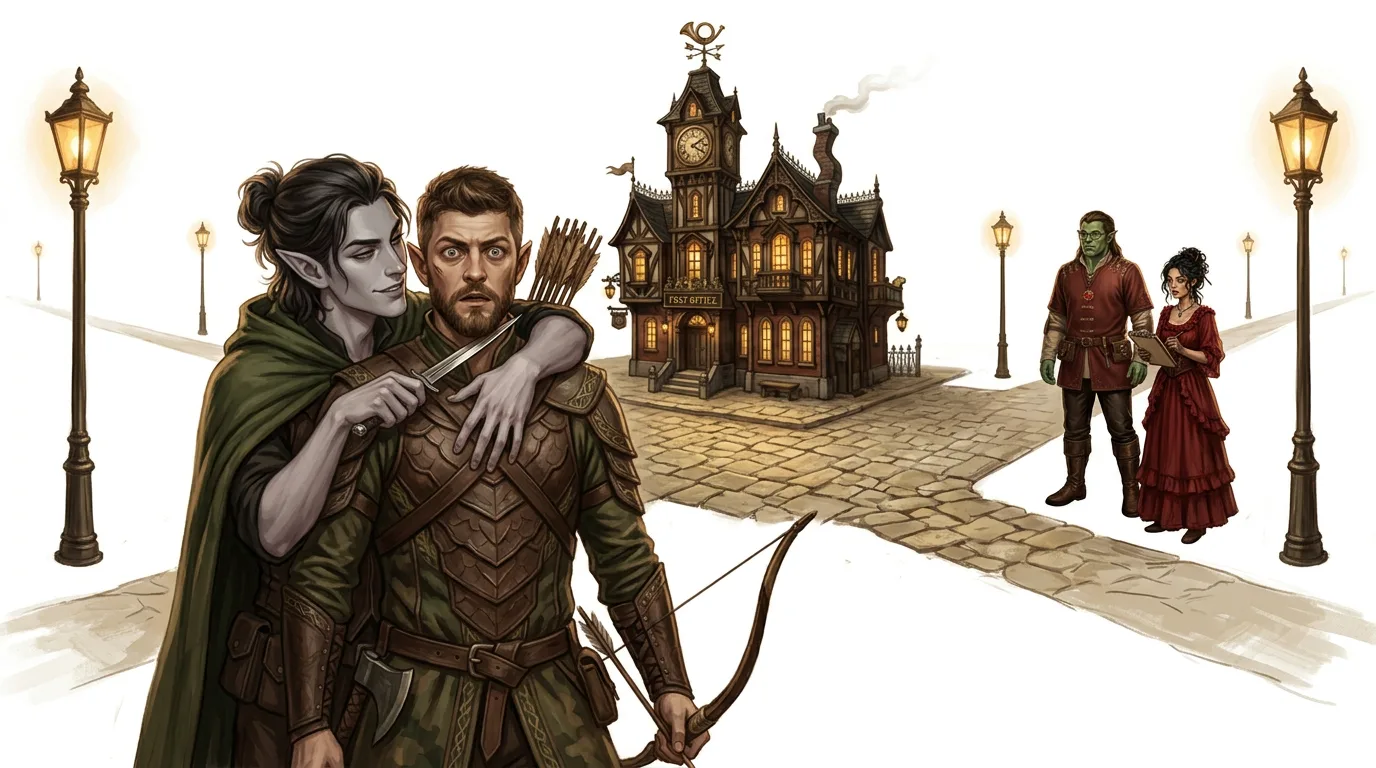
The knife went away and the man stepped around in front of him. He was slight and cloaked, and when he pushed back the green hood Corin saw pointed ears, long white hair and a face that nobody had any business having in a void. The man looked at the others briefly. He looked at Corin a good deal longer, from his boots upward, and did not pretend to be doing anything else.
“My name is Talon,” he said. “I’m the security officer here. My job is to make sure you survive the next twenty-four hours, and hopefully a bit longer. But let’s start small.”
“Is this some kind of pocket dimension?” asked Horatio.
“Extra points for the nerd,” said Talon. “Nobody likes nerds.” He explained. The Everpost had rules, and the first one was that letters always arrived. The second was that the Everpost connected people, and sometimes it connected different worlds. When Agata asked, faintly, whether he meant there were several worlds, he pointed at his own ears and then at Corin’s. The paths out there led to doors, and every door looked like the front door of the post office, because every post office was the same post office. It was everywhere and nowhere, he said, and he left the details to the nerds. They should not wander off into the white parts, because there was nothing there at all, no food and no water and no way back, and unless they could photosynthesize they should stay on the paths. They should not lose their badges, because without a badge the broom closet was only a broom closet and the doors out here led nowhere.
“Will you be coming with us?” Corin asked, before he had quite decided to.
Talon stepped closer. “Being around you sounds like a fun time,” he said. “But I’m only here to train you.” They trained in the void, he explained, because no one else was out here to see, and because he could feel a few suppressed emotions in the group that might break free, and nobody wanted to be around when someone suddenly turned into a bear. He flicked his hand, and a straw dummy appeared on the white ground wearing a dented knight’s helmet. “This is George. He’s a little nervous, so he dressed up.”
Asked whether the other worlds were a secret, Talon said that rules were Portobello’s department, but that people tended to panic about aliens, and that in human villages Corin should hide his ears. Horatio asked about tusks. Talon suggested jewelry. Corin said he could disguise himself, but not anyone else, and nobody asked him how he knew that he could.
Then they hit George.
Dorian went first with his spear and put it straight through the straw where a heart would be. Corin took thirty paces back, which was not far for him. He nocked an arrow, and as he drew he looked at Talon, and Talon was looking back, and Corin winked. Then he loosed. The arrow took George in the neck and the dark power his father had trained into him went with it, and the dummy went up in a column of flame. Straw and helmet came down separately.
“Impressive,” Talon said, looking at him and not at the dummy. “You might actually survive this job.”
He flicked his hand and George came back. This time Talon lit a small fire under his feet to show them what happened to someone who could not jump aside, and then asked the magic users for a demonstration. Horatio did an elaborate thing with his fingers, and a silvery mist bloomed in front of George’s helmet. George’s head tried to follow it. Talon explained, with some enthusiasm, that it was easier to hit someone from two sides at once, and stepped behind the dummy and invited Agata to stand opposite him.
She took a pencil out of her hair and her notebook out of her sleeve and drew, in half a second and very elegantly, a picture of George with his chest ripped open. She touched the page. Nothing happened. Her face did several things. She drew him again, this time with his throat open, and touched the page, and George’s neck went black and slowly split, showing the wooden post inside. Straw, Corin noted, did not bleed.
“That sounded fun,” said Talon.
He went through the rest with them after that. Actions and reactions, hiding, cover, the difference between the things you had to aim and the things other people had to dodge. Corin already knew most of it. His father had taught him the same lessons with less charm.
When they were done Talon congratulated them on still having all their fingers. He reminded them of the contract, in which they had agreed that the Everpost bore no responsibility for lost limbs, hearts, souls or minds. Their first assignment would come from Maggie, he said, because she liked them and wanted to be there for their first contact with the book. He looked at Horatio. “You’re the book bearer? Good luck with it. I never liked mine.”
“Go back to the kitchen,” he said. “Try the raisin biscuits, even if you don’t like raisins. And be nice to Maggie.” He winked at Corin, and pulled his hood up, and was gone before anyone saw him leave.
Maggie was making dinner when they came back through the broom closet, and the kitchen smelled of roasting and baking and the particular kind of warmth that makes people take their shoes off. She dried her hands, sat them down and brought out a book.
It was bound in brown leather, with a long leather string wrapped around it several times to keep it shut, and she held it out to Horatio with both hands. “I still remember the day I got mine,” she said. “You never forget it. Now remember, you’re not the leader of your group. You’re all colleagues. The book bearer just keeps everyone on track.” She watched him take it the way a mother watches a child being handed a violin.
Horatio unwound the string and opened it. The first page was typed in small, even letters, and he read it out loud.
The rest of the page was empty. Horatio felt a great and quiet respect. It sounded like Mr. Grimm, and he had not expected to find that a comfort.
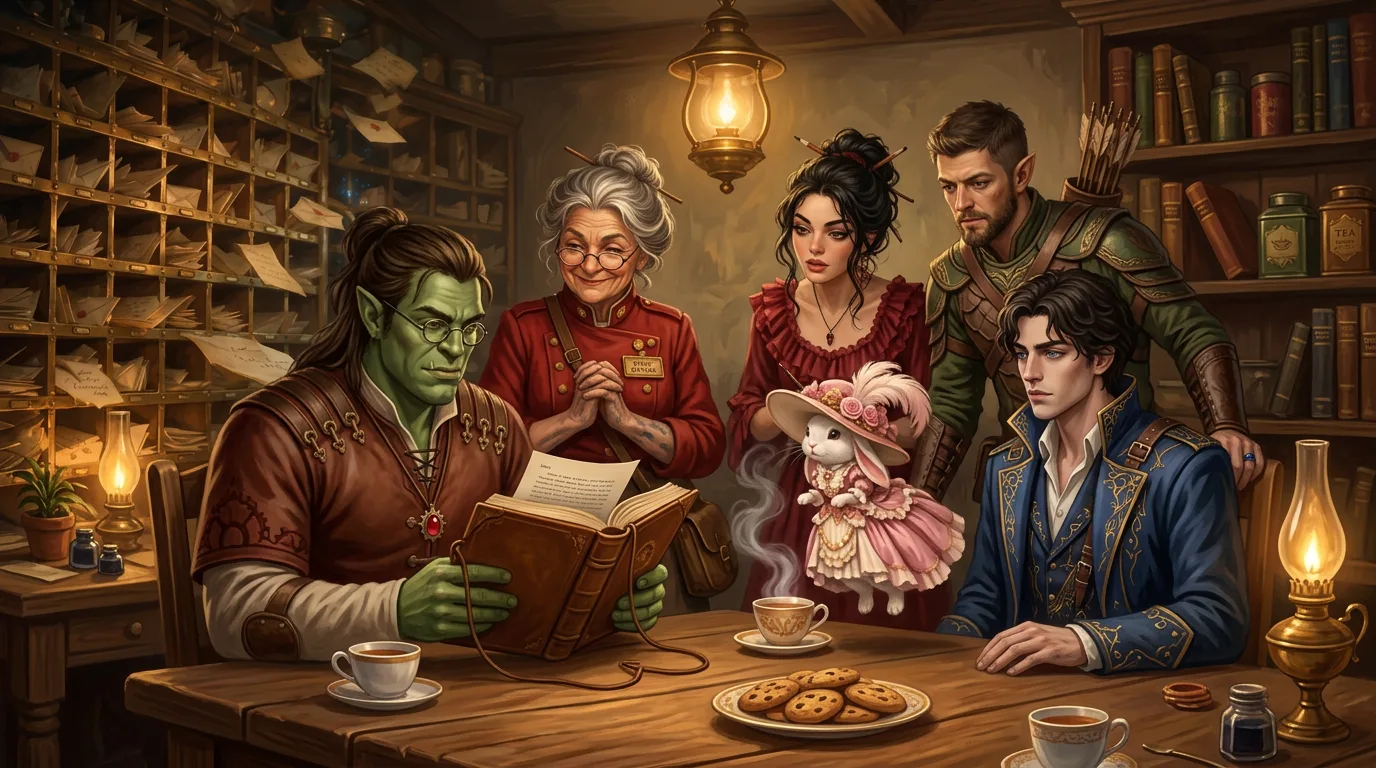
“What do I write?” he asked.
“Whatever you like,” said Maggie. “Just ask it for your first delivery.”
He wrote: Dear book, we are now ready for our first delivery. Sincerely, the Special Task Force. The ink sat still for a moment. Then the letters on the page shivered and slid, all of them at once, and he turned the page without quite deciding to, and new words were typing themselves in the same even letters. Welcome to the Everpost, dear user of the book (Special Delivery Task Force). Your first route will be provided in the morning.
“The instructions are very clear,” said Horatio. “I appreciate that.”
Dinner arrived. Maggie put a different dish in front of each of them. Agata got a bowl of soup and went quiet over it and then wiped her eyes with her napkin when she thought nobody was looking. Dorian got a pastry and stared at it for a long time before he ate it. Corin got a meat stew and held the spoon without moving. Horatio got a biscuit, round and plain with a thumbprint of jam, the same biscuit a dwarf had once given a small boy in a post office far away, and he held it in his palm and did not bite it for a while.
Over dinner Corin asked Maggie how long she had worked for the Everpost. She said time moved differently in different worlds, and asked where he was from, and when he said Sylvanthe she paused, and then said that in Sylvanthe time it would be around two thousand years. She came from Vael’Anor, she said, but they had lost contact long ago. The door had just stopped opening one day. When Agata asked whether she was human, Maggie laughed and did not answer, and Agata turned to Horatio instead.
“And you? What are you?”
“My designation is half-orc,” said Horatio.
“So one of your parents was an orc? That’s fascinating.”
Talon came in and sat down, and a little later so did Mr. Grimm, keeping a careful distance from both the fire and Talon. Agata asked Mr. Grimm what he was. “I am a mushroom,” said Mr. Grimm. He added that under regulation 149 he was not required to disclose where he came from. Behind his back, Talon rolled his eyes and said he was from Gallow’s End, though he had no family there anymore and had spent the last few decades here.
“Is it far?” Agata asked.
“My dear child,” said Maggie, delighted. “We are an interdimensional post office. Nothing is far.” And she talked about the mail, about how the world needed more of it, how the more people wrote to each other the better the world would be. Horatio listened with half his attention and watched her with the other half. He heard it again, the thinning place in her voice, and this time it was wider. Under all the brightness she was afraid, and sad in a way that had been going on for a very long time.
“Why does the world need more mail?” Dorian asked.
“Because what would the world be if we stopped talking to each other?” said Maggie. “The world is getting more fragile by the day.” Then she jumped up and said, “Dessert!”
Later, when Talon and Mr. Grimm had gone, Horatio broke a habit of many years and untied his hair. Agata told him she loved it, and he said, “I do take good care of it,” and meant it. Maggie told Corin that she had never been in a special task force herself, only on regular delivery. The last task force had been two hundred years ago, and one of them had been lost in action. The rest had retired and had children. She did not know why they were needed now. The book chose who it chose.
Dorian had fallen asleep by the fire. He was mumbling. “Don’t burn me. No fire. Don’t burn me.” Maggie went over and bent down and whispered a few words into his ear, and his face smoothed out and he slept on.
Upstairs there were doors with their names on them. There was one for each of them and one that said Finbarr, which nobody could explain, and one for Talon. Horatio counted them twice. Maggie had spoken of other teams. There were no other rooms.
In the morning, after breakfast, the book had a second page.
Below a line marked for the signature of the addressee, in looping purple handwriting that sloped uphill:
Good luck, my dears! Don’t mind the book, it means well. Do enjoy yourselves, and don’t hurry back on my account. Bring me one of those little honey cakes if you think of it. M. ♥
There was a small heart after the M.
Maggie insisted she had not written in his book, only in hers, and that the book passed things along when it permitted.
The letter was in a numbered locker in the cellar. Agata took it and held it against her chest. In the void Maggie stood waving in the door of the post office and pointed out, since nobody had asked, that the lamps were counted clockwise from the one straight ahead. At the third lamp the path split three ways, and Corin said he smelled hay on the left, so they went left, and there was a door standing in the white with nothing behind it. It was the post office’s front door. Corin pushed it open and stepped through, and they followed.
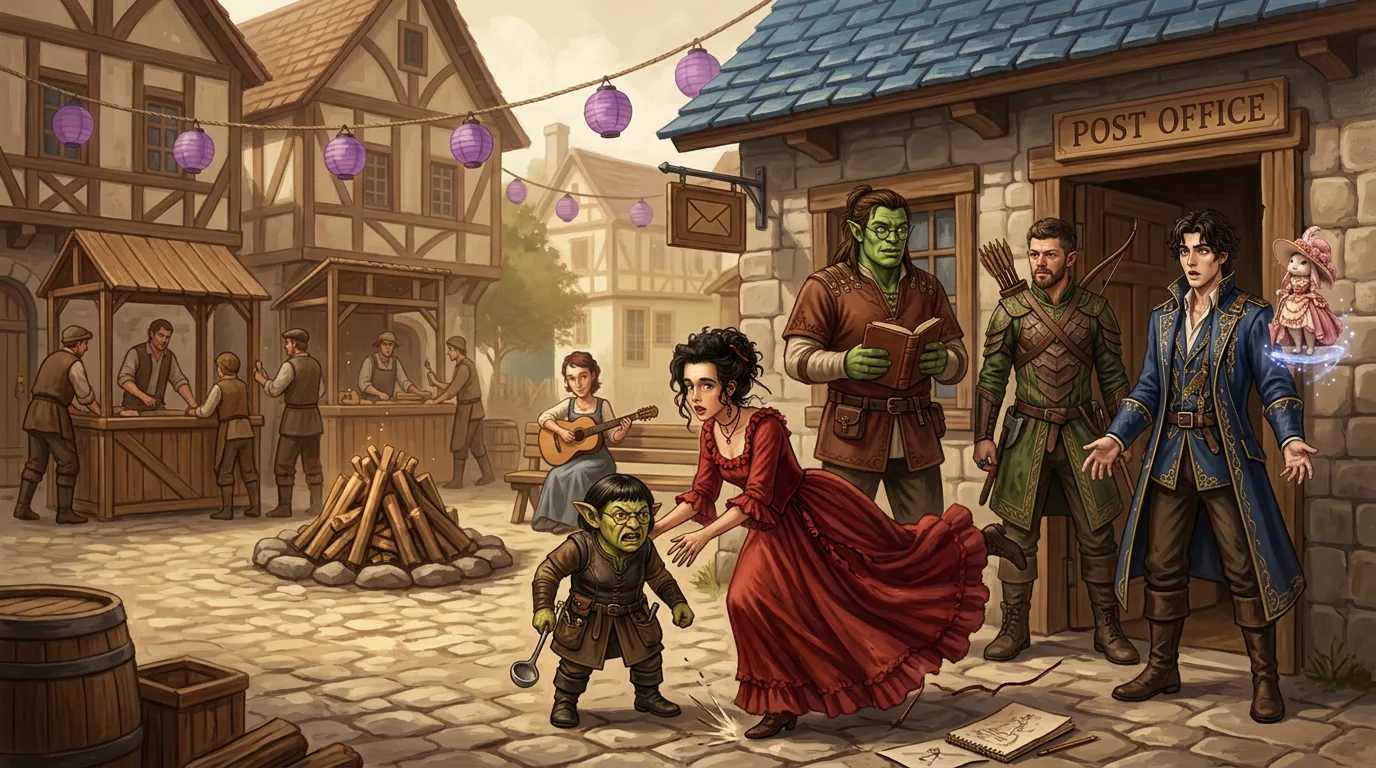
They came out through the front door of a different post office onto a square full of noise. It was midday, which it had not been a moment ago. Purple lanterns hung on strings from every roof, a woman was playing guitar by a bonfire nobody had lit yet, and everyone around them was busy building a festival. Somebody shouted about the summer solstice.
Agata took one step forward, looking up at the lanterns, and fell over.
The thing she fell over was a small green woman with a soup ladle on her belt, who swore at her in several directions at once. “Don’t you have eyes in your stupid human head?” The woman untangled herself, brushed off her skirt and was gone into the crowd before any of them could say sorry.